

The cost of living crisis has meant that many have had to adapt their food buying habits. According to an article in The Guardian, many families are now eating less healthily due to the financial squeeze, turning to ready meals and more processed foods.
Despite the financial pressures we are experiencing, there are things we can do to help us eat well while staying on a budget. In this article we’ll cover top tips and explore what types of foods help contribute to a healthy balanced diet.
What does eating well look like?
The UK Eatwell Guide offers recommendations on the balanced distribution of food groups for a nutritious diet. It outlines the suggested proportions of food groups to be consumed over a specific time frame. For example, if you laid out all the food you consumed in an average week, month or year, the proportions are advised to look in-line with the guide.
Let’s look at each section of this guide in more detail and explore how you can incorporate some of these foods into your diet whilst on a budget.
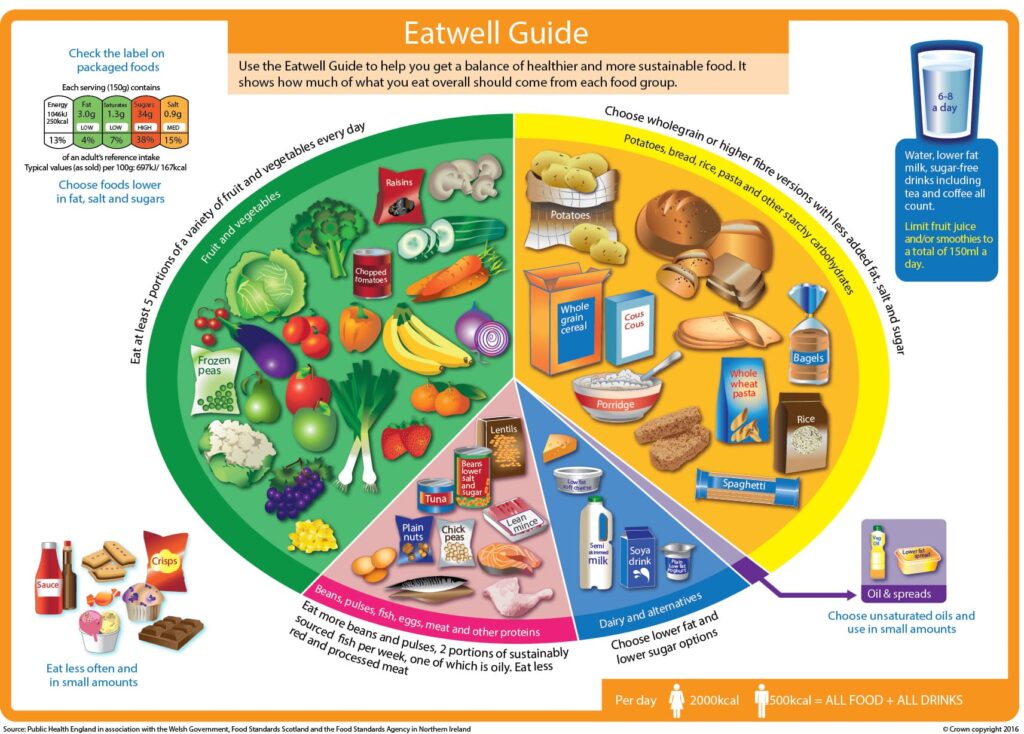
Fruit and vegetables
Fruit and vegetables are essential for our health due to their rich nutrient content, including vitamins, minerals, fibre, and antioxidants. They contribute to disease prevention, support heart health, aid in weight management, promote digestive health, and provide hydration.
Additionally, the diverse nutrients in fruit and vegetables are linked to improved immune function, better mental wellbeing, and healthy skin.
Tips on a budget:
- Choose fresh seasonal fruit and vegetables. Typically these are in abundance and are usually included in deals or have lower prices.
- Buy loose fresh fruit and vegetables.
- Choose the ‘wonky’ or supermarket branded versions.
- Frozen or tinned fruit and vegetables can be good value for money and come pre-prepared. If choosing tinned produce, opt for them being in water or fruit juice to avoid added sugar and salt.
- Dried fruit such as raisins and sultanas store well and have a long best before date which means wastage is less likely.
Portion sizes:
- Aim to have at least five portions of fruit and vegetables a day.
- One portion is 80g or about the size of your fist. One portion of dried fruit is 30g.
Starchy carbohydrates
Starchy carbohydrates, including potatoes, bread, rice and pasta provide energy for the body. They support us with physical activity and daily functions and can offer nutrients such as fibre, vitamins, and minerals. Try to pick wholegrain options (such as wholemeal bread, wholewheat pasta and brown rice) as these contain more fibre and nutrients, and help us to feel fuller for longer.
Something to bare in mind is that the portion size illustrated in the Eatwell Guideline may not be suitable for everyone. For example, if you are not getting the recommended amount of physical activity each week you will likely require less starchy carbohydrates – as your body will not be using as much energy. For example, a large plate of pasta (whether wholemeal or white) will spike your blood sugar levels and can end up getting stored as fat if you are not burning off the energy.
If you are more sedentary, try to get more physical exercise into your routine or consider replacing some of the starchy carbohydrates on your plate with vegetables or protein.
Tips on a budget:
All dry-store food and can be bought cheaper in bulk. They also have long best-before dates helping to minimise waste.
Portion sizes:
- Try to match the portion size of starchy carbohydrates on your plate to the level of physical activity you engage in. For example, those who are regularly physically active may have a third of carbohydrates on their plate, whereas someone less active may just have a quarter of carbohydrates on their plate.
- Choose high fibre starchy foods (like wholemeal and wholegrain) and restrict the amount of processed carbohydrates (such as white bread).
Dairy and alternatives
Dairy and dairy alternatives offer essential nutrients that contribute to our overall health. Dairy products are rich sources of calcium and protein, supporting bone health, immune function, and muscle maintenance.
Unsweetened calcium-fortified dairy alternatives like soya milks, soya yogurts, and soya cheeses also count as part of this food group, and can make good alternatives to dairy products.
To make healthier choices, go for lower fat and lower sugar options. Sources of dairy and dairy alternatives include milk, cheese and yogurts.
Tips on a budget:
- UHT long-life milk and dairy alternative milks can be bulk bought helping to minimise waste.
- Choose supermarket own brands for better value for money.
- When buying fresh dairy check for the best use by dates. In some cases, certain products may be able to be frozen (always check labels for guidelines).
Portion sizes:
- Aim for 2-3 portions a day. For example, a 30g portion of cheddar cheese would be about a matchbox size, a portion of milk would be one glass and a portion of plain low-fat yogurt would be a 150g pot.
Beans, pulses, fish, eggs, meat and other protein
These types of foods are all good sources of protein, vitamins and minerals that our bodies need to function properly and stay healthy. Pulses such as beans, peas and lentils are good alternatives to meat because they’re lower in fat and higher in fibre.
Meat is a good source of protein, vitamins, and minerals, but some meats can be high in saturated fat, so try to choose lean cuts and minimise your intake of red and processed meats (like bacon, ham and sausages).
Fish is a great source of protein and omega-3 fatty acids, which are important for our heart health and brain function. Oily fish such as salmon, mackerel, and sardines are particularly rich in omega-3s and are our richest food source of vitamin D.
Eggs are also a good source of protein, vitamins, and minerals. Other sources of protein include nuts, seeds, tofu, and legumes – which can be a good alternative to meat for vegetarians and vegans.
Tips on a budget:
- Tinned beans and lentils can offer better value for money.
- When purchasing meat or substitutes, check the price per kg.
- Tinned or frozen fish can be cheaper than fresh. Frozen meat can also work out cheaper than buying fresh.
- Cheaper alternatives to salmon that still contain omega-3 include mackerel, sardines, and trout.
Portion sizes:
- There does seem to be a link between red meat and bowel cancer, so try to limit this to one portion per week. Processed meats (such as bacon, sausage, ham and pate) have a stronger link to bowel cancer, so try to minimise your intake of these.
- Aim for two portions of fish per week (such as 2x 140g) including a portion of oily fish.
- One portion of pulses and beans is about three heaped tablespoons.
Oils and spreads
Although some fat is essential in the diet, as a nation we generally consume too much of this food type. When it comes to using oils and spreads, use small amounts, and use saturated fats in moderation. If cooking with oils and spreads, do so on a low to moderate heat, to avoid the fat potentially turning into a trans-fat.
Tips on a budget:
- Most unsaturated fat sources can be bought in bulk and decanted into smaller bottles, allowing for the cost benefit of bulk buying. Also, these types of oils can have long best-before dates helping to minimise waste.
Portion sizes:
- Try to only use small amounts of oils and spreads, such as one teaspoon of butter or one teaspoon of oil.
One size does not necessarily fit all
Something to bear in mind is that the food proportions illustrated in the Eatwell Guide may not be appropriate for everyone. The amount of starch or protein in the diet is largely dependent on an individual’s genetics, their body composition (muscle mass, body fat percentage etc.), their physical activity levels, and many other factors. There is no one-size-fits-all when it comes to this, and you need to find what works for you.
A part of the guidance that is definitely accurate for most/all people however, is that your diet should be made up of whole, natural, minimally processed foods, while minimising your intake of sugary and processed foods. These processed foods should be limited and only had in moderation.
Tips before you do a food shop
- Make a meal plan for the week. This doesn’t have to be very rigid, but having an idea of what meals you will make can allow you to buy what’s necessary and minimise impulse buying.
- Check the cupboards, fridge, and freezer before going out. This enables you to see what ingredients you already have, and where there might be some gaps. It will also stop you buying items you don’t need.
- Try not to shop when you’re hungry as studies have shown we tend to buy more when we are. We might even be more inclined to buy highly palatable foods, which are typically higher in sugars, salts, and fats. Perhaps even intentionally have a snack before going to the shop, to make sure hunger levels aren’t high.
Tips during your food shop
- Buy dry foods in bulk as the shelf life is long.
- Buy frozen or tinned versions where possible, as these tend to be cheaper than fresh.
- Choose supermarket brands as again these tend to be cheaper options.
- Check the reduced sections and see what foods can be stored or frozen.
- Be aware that deals aren’t always the most cost-effective way to buy.
- Read the shelf labels to make sure you’re getting the best value for money. Products can be sold in different package sizes which can sometimes make it difficult to compare the price of items. By checking the label for the ‘price per kg’ information, you can better understand the most cost-effective choice when comparing different quantities of the same food.
Things you can do at home
The current cost-of-living crisis has highlighted the importance of managing your cooking methods, as some may be more costly than others. For example, cooking with the microwave or using an air fryer (if you have one), will typically use less energy than cooking with the oven or gas hob – helping to keep your energy bills down.
Batch cooking can also help. By cooking a few portions at a time and freezing leftovers you can enjoy dishes such as chilli, Bolognese and stew while reducing your overall energy usage.
Further support
BBC – Healthy recipes on a budget.
NHS – Healthy recipe ideas.
British Heart Foundation – Seven days of healthy meals on a budget.
British Heart Foundation – Ten ways to eat well and save money.
NHS – Meat in your diet.
Food and Agriculture Organisation – Examples of dietary guidelines from around the world.
Sources:
www.gov.uk/government/publications/the-eatwell-guide
assets.publishing.service.gov.uk/media/5ba8a50540f0b605084c9501/Eatwell_Guide_booklet_2018v4.pdf
www.bhf.org.uk/informationsupport/support/healthy-living/healthy-eating/healthy-eating-toolkit/food-portions/oils-and-spreads
This information was published December 2023.